|
|
|
How Do I Join?
Can We
Make Menu Selections Lunch & Dinner Children's Menu Links to Club Related Sites
Unique collectibles
Dr. Lee's Blog Page
|
The History
Walt never stopped examining the world around him and wherever he traveled, he enjoyed noting details, both small and large. Even if a project was nearing completion, Walt believed in 'plussing it', his term for making something grander. Walt also looked for opportunities and if none were found, he possessed the incredible ability to create them. The 1964 World's Fair proved to be such an opportunity and Walt had a brilliant idea as to how he and his crew from WED (Walter Elias Disney) Imagineering, could make their mark and also benefit his own theme park.
Ford: Ford's Magic Skyway - An automated ride-through attraction, showing the
chronological history of the world. Guests rode in Ford vehicles.
While at the World's Fair, Walt visited the private VIP lounges of the large corporate sponsors and he loved the idea of having a special place to entertain guests, VIP's and investors. The concept stayed with Walt as New Orleans Square was in the developmental stages. As the World's Fair preparation was progressing, Walt, being the creative genius we all know and love, approached the companies for which he had built the attractions and asked if he could take them to Disneyland. The companies would sponsor the attractions and millions of guests would continue to enjoy them. The idea was brilliant and allowed Walt to add attractions to Disneyland which had been essentially paid for by their initial sponsors. Everyone benefited. Of course, this was the initial plan and Walt was careful about following through on every detail.
You'll enjoy this video. As the story goes, General Electric was on board with the idea of allowing Walt to install what would become the Carousel of Progress in Tomorrowland, but a few of their executives wanted Walt to install a VIP lounge. They wanted it placed within the attraction for them to enjoy whilst visiting the park. Walt explained that this would be difficult as the attraction would be in Disneyland and consuming alcohol in an attraction wasn't something he was keen to support. He told them however that he was developing a new land, New Orleans Square and there would be room to build a lounge. They loved the idea and the private lounge was added onto the construction plans and therein built.
As a result of the 1964 World's Fair, we have Great Moment's with Mr.
Lincoln, It's a Small World, the dinosaurs within Primeval World for the steam
trains to pass through and what used to be The Carousel of Progress.
In May of 1967 the lounge which had been used to entertain investors, VIP's,
Walt's family and friends was officially opened as Club 33.
The below material was taken from the Club 33 Official History Sheet
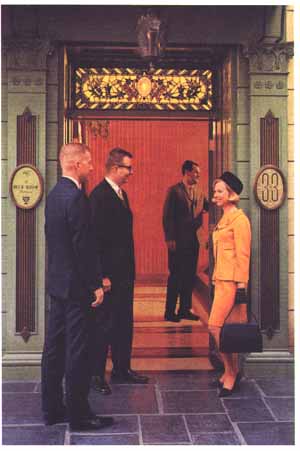
Years ago, Walt Disney felt that a special place was needed where he could entertain visiting dignitaries and others in a quiet, serene atmosphere where superb cuisine and distinctive decor would complement one another. He asked artist Dorothea Redmond to provide watercolor renderings of what such a place might look like. Accompanied by renowned decorator Emil Kuri, Walt and his wife traveled to New Orleans to select many of the beautiful antiques that are on display. After years of planning, Club 33 became a reality in May of 1967. Sadly enough, it was never seen by its creator because of his untimely death five months earlier. Club 33, so named after its address, 33 Royal Street, is comprised of two dining rooms and several adjoining areas, all of which hold a wide array of magnificent antiques and original works of art. After ascending in the French lift to the second floor, guests enter into The Gallery. Here they find interesting items such as an oak telephone booth with beveled leaded glass panels adapted from the one used in the Disney motion picture "The Happiest Millionaire" and a rare console table which was found in the French Quarter of New Orleans. In The Gallery, as elsewhere in the Club, are many original works by Disney artists and sketches done as design studies for New Orleans Square and the Pirates of the Caribbean attraction.
The Main Dining Room is decorated in First Empire, recalling the era of Napoleon and the early nineteenth century. Three glimmering chandeliers and wall sconces illuminate the entire room. Much of the framed artwork on the walls is again, the work of Disney artists. Fresh flowers, parquet floors, and antique bronzes create an atmosphere of serenity and warmth. The Trophy Room is the second dining room and offers a more informal atmosphere. The cypress-planked walls provide an excellent background for sketches done as design studies for the Jungle Cruise and Tiki Room attractions. The design of the room incorporates the use of microphones in the center of each chandelier and a vulture with the ability to speak. Walt Disney's intention for this concept was humorous in nature, as the vulture was to converse with guests during dinner. The Trophy Room also contains a number of antiques and it is usually sunlit from a long row of windows. Today, Club 33 functions as an exclusive private club where members or their guests may enjoy a gourmet meal complemented by the finest wines. Tradition, accompanied by gracious hospitality, has been the hallmark of Club 33 since its opening day . . . and will continue to be for many years to come. Below is one of the original Club 33 membership brochures
The young man with the orange sleeved carving coat standing behind the large silver chafing dish is Mr. Roger Craig. He later became the club's Asst. Manager and then rose to Manager. He explained that when this photo was taken, the black and gold coats for the club were not finished, so they used the carving coats from Plaza Inn, hence the orange color.
The following YouTube video is courtesy of
http://www.mousefiles.com
The following video is courtesy of
DisneyParks videos. You can visit their video gallery page at the following URL.
http://www.youtube.com/user/DisneyParks
|


 Club
33, Royal Street, New Orleans Square, Disneyland
Club
33, Royal Street, New Orleans Square, Disneyland